

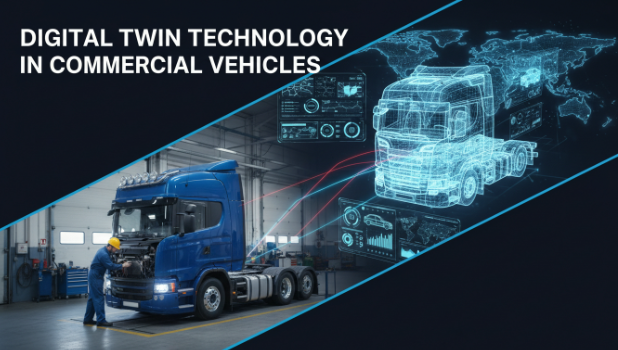
“Digital twin” has become one of those terms that gets dropped into every fleet tech conversation without much explanation. Vendors use it in pitch decks. Trade publications mention it like everyone already knows what it means. And most fleet managers I’ve spoken to nod along while quietly wondering whether it’s actually different from the telematics system they’ve been running for years.
It is. But the difference isn’t as futuristic as the name suggests.
A digital twin is a virtual copy that keeps updating
At its most basic, a digital twin is a software model of a physical vehicle that mirrors its real-time condition. Sensors on the truck’s ECU feed data into a cloud platform, which builds a continuously updated replica of how that specific vehicle’s components are performing right now.
Not an average across your fleet. Not a manufacturer’s spec sheet. A model of this particular truck, with this engine, this many miles, operating in these conditions, driven by this person.
The difference from traditional telematics is the direction the data flows. Telematics tells you what already happened. The engine overheated at 2:47 PM on Route 9. A digital twin tells you that the cooling system on truck #4817 is trending toward a failure in the next two to three weeks based on how the coolant temperature has been behaving relative to ambient conditions and load patterns.
That distinction matters more than it sounds.
Where the value shows up in commercial fleets
The commercial vehicle and fleet digital twin market hit roughly $1.7 billion in 2025, according to Global Market Insights, growing at about 20% annually. That’s not hype money. Fleet operators are spending it because the returns are specific and measurable.
The biggest one is predictive maintenance. A Class 8 truck sitting on the shoulder of I-40 with a failed turbocharger doesn’t just need a repair. It needs a tow, a rescheduled delivery, possibly a penalty for a missed appointment, and a driver who’s stuck waiting for hours. The total cost of that single event can easily reach $5,000 to $10,000 when you account for everything.
Digital twin platforms catch these failures early. Intangles, for example, uses predictive health monitoring built on physics-based AI models that track engine, coolant, DPF, battery, alternator, and air intake systems simultaneously. Their platform can flag a developing problem days or weeks before a diagnostic trouble code fires, which means the repair happens in the shop on a Tuesday morning instead of on the highway at midnight.
A municipal fleet of 1,400 vehicles, including 90 refuse trucks from three different OEMs, deployed this kind of system and found faults in 30% of the trucks before any DTCs appeared. The result was around $500 per vehicle per month in cost savings. That’s not theoretical. That’s documented.
It changes how you think about maintenance scheduling
Most fleets still run on time-based or mileage-based maintenance schedules. Oil change every 15,000 miles. DPF cleaning every 6 months. Belt inspection at 50,000 miles. The problem is that trucks don’t degrade on schedule. A truck running light loads on flat highways ages differently than the same model hauling full weight through mountain passes in August.
Fixed schedules either catch problems too late or waste money servicing things that didn’t need it yet. Both cost you.
A digital twin flips this to condition-based maintenance. The platform knows, based on actual sensor data from that specific vehicle, when a component is approaching its performance limit. So instead of pulling a truck off the road every 20,000 miles whether it needs it or not, you service it when the data says it actually does.
Fleets running this way typically see breakdowns drop significantly while uptime improves by 10 to 30 percent. The maintenance budget doesn’t just shrink. It gets reallocated from emergency repairs to planned interventions, which are cheaper, faster, and less disruptive.
Driver behavior looks different through a digital twin
Here’s something that surprised me when I first dug into this. Digital twins don’t just monitor the vehicle. They connect driver behavior to mechanical outcomes in ways that basic telematics can’t.
A standard telematics system might tell you that a driver scores poorly on harsh braking. Fine. But a digital twin can show you that this driver’s braking pattern is accelerating brake pad wear by 40% compared to peers on the same route, and that at the current rate, the truck will need brake service three weeks ahead of schedule.
That changes the conversation entirely. You’re not coaching a driver because a scorecard says they’re bad. You’re showing them a direct dollar cost attached to a specific habit. Platforms tracking this kind of correlation monitor 20 or more driver behavior exceptions, from over-speeding to excessive idling to gear misuse, and rank drivers against each other so managers can focus coaching where it actually moves the needle.
One fleet reported an 85% improvement in vehicle safety metrics after combining predictive diagnostics with driver behavior analytics. That’s partly because drivers respond better when you can show them data instead of lecturing them.
The EV angle is becoming critical
Digital twins matter even more for electric commercial vehicles. Battery degradation is slow, silent, and expensive. Unlike a diesel engine where you can often hear or smell a developing problem, a battery pack gives you almost no warning before range starts dropping or cells start failing.
A digital twin monitors charging cycles, depth of discharge, thermal behavior, and motor performance continuously. It predicts when a battery module needs attention before range reliability drops to the point where it affects daily operations. For fleets running mixed diesel-and-EV assets, this kind of visibility is the difference between managing battery health proactively and eating a $25,000 replacement bill nobody budgeted for.
Range prediction gets better too. Instead of relying on the dashboard estimate, which commercial vehicles regularly miss by 15-20% depending on load and terrain, a digital twin uses motor torque data, weather forecasts, and historical route performance to give you a number you can actually plan around.
What it takes to get started
Most fleet managers expect a massive infrastructure project. It’s usually simpler. The hardware is typically a device that plugs into the vehicle’s OBD port and reads ECU data. No external modifications.
The software side is where the complexity lives, but it’s complexity you don’t build yourself. Platforms handle data ingestion, model training, and alert logic. Your job is to pay attention to the alerts and act on them, which is where most implementations succeed or fail.
Start with 50 to 100 vehicles. Measure breakdowns, unplanned maintenance, fuel efficiency, and uptime over 90 days. If the numbers move, scale it.
The math keeps getting harder to ignore
The commercial vehicle digital twin market is projected to hit $11.8 billion by 2035. That growth isn’t coming from marketing budgets. It’s coming from fleet operators who ran the math and realized that knowing what’s about to go wrong with a truck is worth significantly more than knowing what already went wrong.
The fleets adopting this now are building a data advantage that compounds every month. More history means better models. Better models mean fewer surprises. The gap between a fleet running digital twins and one managing by check engine lights gets wider every quarter.
If you run commercial vehicles and you haven’t looked at this yet, you’re probably overpaying for maintenance and downtime. That’s not a sales pitch. It’s just math.